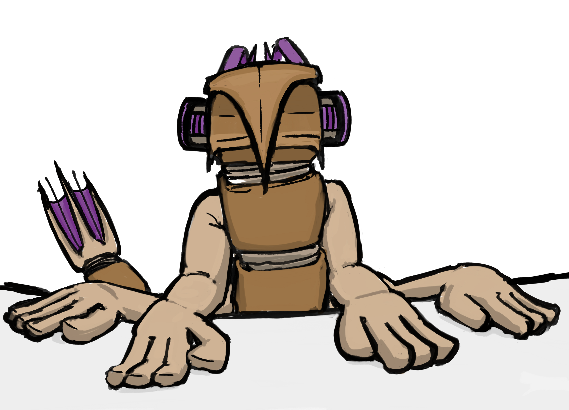
The Ikirmites in Epoch 0


An overview of the Ikirmites in Epoch 0.
To understand the Ikirmites, their homeworld of Ikirma needs to be understood.
Ikirma
Ikirma is a world that once was very earthlike, orbiting its K-class sun for eons as a complex biosphere developed in its 0.87G gravity well. About 107 million years, a freak nearby passing star related incident destabilized the planetary system which Ikirma orbited, careening the earthlike world into the cold, unforgiving void of interstellar space. A mass extinction event ensued, with much of the information of these epochs still being uncovered from the icy expanses of frozen over geography to this day.
Yet, their homeworld's geological activity never stopped. It has a 12 km deep ocean, in total abyss covered by 4 kilometers of ice. The atmosphere has condensed into ice for the most part, sustained with a thin veneer from periodic plumes that slowly have sculpted various bluffs and scarps across the surface of the world. The world is vantablack from afar despite its icy surface due to there being no other world or sun around for trillions of kilometers. Some interstellar objects, sure, but the world was in the void of space. The geological records have increased activity from periodic nearby passing events that led to periods of heavy vulcanism, including a time as recent as 1.5 million years ago.
At the current time, Ikirma is orbited by two small moons that appear to be abducted from the aforementioned nearby passing events over the spans of time that Ikirma has drifted about the galaxy.
Life on Ikirma is one of perpetual darkness, with the glow of rift basin regions and thermal rifts as the main central lifeline for the biosphere which developed in the depths where life continued to thrive despite the icy crust. The biosphere as a whole is not covered here, but the Ikirmites themselves are heavily covered.
The Ikirmites Themselves
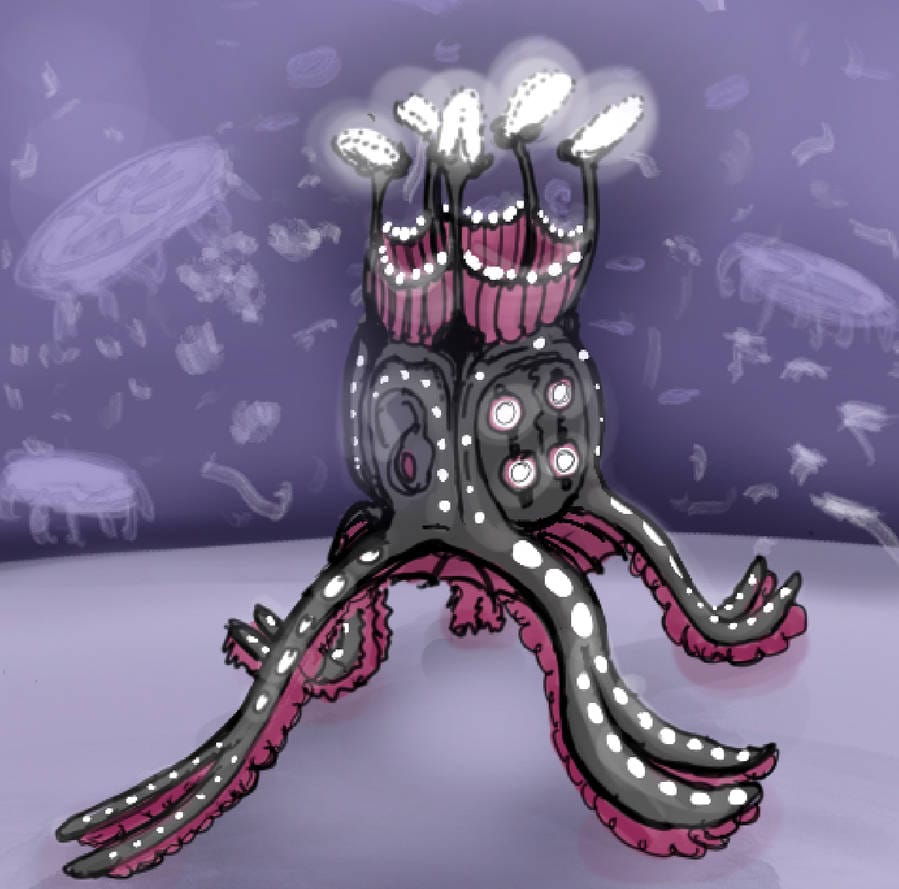
The Ikirmites are large. They are usually about 20-30 feet from the base of their tentacles to the tip of their tendril crowns. The Ikirmites characterized primarily by the roes of concentrated bulbs of light running across their bodies. Their tentacles have two sets. There are five root-tentacles situated around their base where their mouth orifice is. They are used for both chemotrophic absorption (so they tend to be warmer than their carbon black dermis). The root-tentacles are also their prehensile appendages, with the tentacles splitting four sets of 2 root-tentacles. Menawhile, the crown tendrils are used for 'signaling' to other ikirmites across vast spans of oceanic depth. Due to the Ikirmites being large organisms without worry of predators, they do not have much concern of these signals attracting unexpected guests.
Swimming wise, the Ikirmites are able to move shockingly fast, butalso "run" on the sea floor with their tentacle-roots as needed. Their muscular system is mostly soft bodied, but their dark exterior is incredibly bony in texture, with a rough and thick mantle that encases the soft rubbery flesh within. Their light limbs have bulbous masses of bioluminescent cells and are very ligament-like, the result of a prior earlier sessile polyp phase of their lives that is more rooted and reliant on chemotrophy.
Reproduction
Thee Ikirmites are dimorphic in biological sex, with males generally being similar to females. The Ikirmites will mate without regard to the gender of a mate with a mating selection system built again in their semiotics. As the point of pair bonding is is semiotic matching. As a result, both male and female Ikirmites are selected towards the goal in mating. The low regard for what biological sex their mate actual is comes as a product of how they are able to live long life spans and one batch from the third mating attempt already is 3-4 offspring.
The Ikirmites have staged life cycles with a more sessile stage of life where younger Ikirmites live on the chemotrophy of the vents along with the food the caretaker ikirmites assigned to the polyp garden feed them. Good, cultivated detritus instead of the crud from the convention current pumps was part of what gave the ikirmite better nutrition to work with in the first place.
Ikirmite reproduction happens with base-base copulation and then the release of polyps 11 months later that plant themselves around hydrothermal events. These polyps are more managed by intelligent Ikirmites who arrange them in the vent gardens. There are usually only 3-4 polyps per batch, as the Ikirmites are low numbers in reproduction and they can't actually afford to lose polyps.
The expensive polyps led to intensive care of the vent gardens as crucial for their continued survival. And it is believed this de facto polyp gardening mixed with the constant pressure to improve detritus nutrient saturation along with the 7 earth years on average it takes for a sessile Ikirmite to grow into a motile Ikirmite and 24 years on average it takes for a motile Ikirmite to develop into an adult Ikirmite. Despite that, the average Ikirmite lifespan without technology was "only" 55 years.
Note: Ikirmite Timekeeping is very reliant on specialized 'timekeeping' ikirmites, usually motile stage ikirmites. They had no day/night cycles to rely on for long term calendars.
The Luminary System
The most unique bodily system of the Ikirmite is their luminary system. The luminary is the organ system responsible for the characteristic biobulbs which line their bodies. These bulbs have a thin membrane about them and are filled with concentrations of luminous algal flora that colonize their bodies in the polyp stage of their life cycle. The ikirmites have cavities upon cavities which incubate glowing symbiotic organisms in their chromatophoric bulbs. The sickly ikirmites often can be identified by their dim brightness. The pouches of flora are reactive to touch, glowing more when caressed.
Various other factors are able to contribute to the intensity of the glow as the whole Ikirmite is an organic LED system due to the various hormonal chemicals they can produce to affect the behavior of symbiotic microbe colonies in their bulbs. The colors can vary from white but they often will still be a brighter color The crown chromabulbs meanwhile exist for higher intensity flashing, with "candles" of specific chroma and even have deposits of magnesium that congeal into a drier biomineral that can be used for emergency flaring or heating. The "eye" chromabulbs are specialized due to their sub sectioned layers, with viscera and pupils embedded in the glow in fashions that allow them to focus or unfocus their glow in a spotlight-like fashion as so needed.
Their tendrils are split between color absorbent hide and the softer, stickier and more prehensile tentacles which are akin to a mix of sundew and suction cups. They are very different from hands as we know them, they are able to voluntarily alter the stickiness and hold in fashions which are useful for tool use based around tentacle type prehensile appendages. They even made tools that activate/deactivate based on how hard they are able to exert suction pressure.
Additional Anatomy Details
The Ikirmite siphon includes frills for respiration, but they are narrow in their application as they are in separate sub-cavities from each other. They appear to be somewhat atavistic, inherited from more streamlined and rapid moving organisms.
Their analog of a gut system is akin to a a sea anemone's gut in the larval polyp stage, but the motile/juvenile and adult Ikirmites have linear guts with differentiated organs as adult Ikirmites need more heterotrophic activities and less detritus. The guts have glowing fluids in their lining that get vomited out for various reasons, such as navigation or breadcrumbing in their confusing chaotic terrains of under-rift hydrothermal regions. Their gut system has a large mantle that leads into the stomach and intestines along with a cecal pouch formed from the original stomach of the larval Ikirmite which leads to the anus.
Along with a gut for heterotrophic consumption, the Ikirmite's violet root-tentacles act as sheets for conducting chemolithotrophy. Ionized, salty liquid media is preferred. The salts and metallic compounds collected often include magnesium, of which get sequestered to the concentrated bulbs seen across their bodies and concentrated into their tendril crown. They may wrap themselves around warm surfaces enriched with magnesium to keep energized even as adults.
Societal Patterns and Psychology as of Epoch 0
The Ikirmite have as a civilization become embedded in multiple affinities produced by their biological heritage as a chemotrophic and heterotrophic organism. The architecture is extremely writhing and dull of spiny lights.
There are a several norms and ontological aspects to the ikirmites which I have to seriously consider for this to work.
For one the Ikirmites are beings who existed only in abyss, with semiotic signals as their guidance and that led to a civilization where such semiotic shepherding is everywhere and used for a vast range of applications. Of which include the natural world and its shifting relations to the numerous inner circles and outer circles of organized activities by the ikirmites.
The Ikirmites in terms of being "structured" have been mostly defined by an economy of semiotics with hidden meanings and values beyond which the usual comprehensions we go by just don't fit well. It is easy to reduce it to special keys, phrases or terms but ultimately what it actually compels itself as are much greater, non-analogous comprehensions of the obtuse.
The Ikirmites have to keep on trotting about, for they must live in the abyss of a world abandoned by its own solar system. A snowball world. That aspect of their existence was only known later, but the secretive and tense aspects of ikirmite existence came about due to the limitations a lack of sunlight imposed. Why they had to make use of both an autotrophic and heterotrophic mode of life. Why they had gained chemotrophic qualities.Ikirmite social structures are embedded and linked chains where tight knit "conspirators" work on all matter of activities in the interest of their groupings. These groupings get called a range of things, with the loose translation to plexus universal being jarring at best to those unfamiliar with the way semiotics and tonal intensities of brightness encode meaning in ikirmite existence.
The various groupings of Ikirmites / Ikirmite Xenosociology
Ikirmite Xenosociology is understood better due to their existence in the Plexus, the same region of the galaxy that humans exist. So more is known about the way the Ikirmites organize themselves than with say, the Glinnvyr or the Aveterriat who exist in a distant part of the galaxy. They can be loosely profiled as follows.
Disclaimer: These are loose categorizations that in practice have overlap or may fail to include other groups. These groupings are a pattern when can be noticed from all the way back in epoch 0, as a result they are relevant to this article.
Affinities
Affinities refers to Ikirmites with shared proclivities that sort themselves into Spheres of Affinities. Affinities unify other ikirmites in the group through shared affinity, they are most like a club of sorts. Often the shared affinity is an interest or cause, but it also can often be a greater project the affinity may in some cases work towards for centuries with generational efforts contained within the affinity as the secrets and scandals stay in the abyss. Affinities can collapse, information leaks that undermine the faith in the affinity, disillusionment from realizing the construction project they spent centuries on had no future after all, fear/distrust of others in the affinity outweighed the passion of action. Affinities are the closest thing the Ikirmites have to actual organized factions, with anything called an Ikirmite 'faction' or 'organization' very often being an affinity group or a cryptic group.
Contrasts
Contrasts refer to a pattern of social interaction seen among the Ikirmites that in effect are antiunions. Where they are in constant rivalry but with a clear inability to exist without the continued existence of the other, to the point there is support that gets given to the other side of the contrast should the need arise. The Contrasts as a result, are often locked in an intentional ritual form of warfare that is less about winning or losing and more about maintaining a constant sense of self by defining the self against the other, feeding off each other in a toxic dependency that ensures a purity of the path they have set for themselves. In practice they fall apart all the time, sometimes splitting or merging into affinities or otherwise simply disintegrating into Flows once more. Such Contrasts have continued to astound even other groups of Ikirmites due to their ability to be weirdly stable despite the chaotic lightshows they produce.
Saturations
Saturations refer to to a rarer formulation of ikirmite cultural groups seen mostly in the open abyss regions where cold seeps were the best one could usually do. Much more spread out and without the prism hierarchy of the contrasts and affinities, the saturations were looser. They didn't intensively cultivate their young to the horror of the other populations- they just let the sessile larvae form and develop with minimal intervention and if they failed, they failed. If they lived, they lived. Such lifestyle is usually seen as outmoded and an artifact of older existence, but it is hardly such to the Saturations. For the Saturated do raise their members in a wide range of ways, with the intensity varying with the temperament of the Saturated Circles in question. A series of different mentorships with different perspectives is expected. They are not nearly as cryptic as the other populations, sharing knowledge is the norm with them. Which to other ikirmites makes them idiots. The saturations still have managed to be uniquely able to manage a vast range of solutions to problems compared to the conditional supports and narrow response ranges / hammer approaches preferred by other groups.
Cryptics
The Cryptics refer to the numerous associations of encrypted entities, often found holed about in numerous nooks and crannies of the molded core matter used to create spindly structures where volumetric alcoves in deep lounges slowly meander. The cryptics have no unity, they can't actually tell half of what is going on due to the discrete approach to cross-group interactions they had continued on with. They have lots of accumulated wealth through trade secrets and research groups setup by the local flow where semiotic intracies enabled a sort of re-invention. At Epoch 0, the Cryptics were smaller and more regional but in the millennia to ensue, their power over Ikirma only would expand to the point they would be the dominate force for a span of time comparable to that of written human history.
Flowers
The Flowers are the common Ikirmites in some regards, they tend to all matter of issues and mostly are a merchantile class and had been since the past. Due to their lack of secrets compared to the cryptics, they are regarded as foolish and incapable of keeping a secret which is usually not seen as what the ideal ikirmite is like. One day they're supporting the Vata League, the next they are being a lesser form of the Cryptics. These ikirmites are the most playful group, at least with regards to continuous play. The Flowers are not usually regarded to be the same as the saturated because they usually come from the vent gardens instead of the seeps.
Venters
The Venters are usually associated with hydrothermal vents where nurses, prospectors and the like are heavily involved. They are the most studious and laborous group of the Ikirmites. More interested in the basal function of societal function and the basics than any high minded abstract fancies. Such pragmatic thinking was widespread. The venters frequently tend to polyps and often are mercenary forces for the other groups with access to volcano tubes or the biological resources of the cold seeps that the venters find horrifying to even tread into.
Convectives
Convectives are more nomadic, spars s and not fun to come across. They followed the flow of convectional currents and are very hunting based, ganging up on the large colonial megafauna in the upper volumes of their world with regular ease.
Pacers
In ancient times the Ikirmites had to rely on a specialized role called at "Pacer" who was used to keep track of a given span of time as the concept of time was not intuitive for the Ikirmites, they knew events and cycles of activity from the vents, but counting the time between them had to be more directly invented than in societies where the skies gave a convenient cycle to existence. Such cycles weren't really a thing with the Ikirmites. Existence was a flow of deteriorating activities. Until the Pacers gave a sense of time that is. The pacer flared their organic lights at regular paces to give a clear signal on how many "paces" have occurred. The rate was meant to be consistent, but the pace could be slower or speed up depending on the intensity of a given operation and the needs of the local cryptocrats. Ikirmites in more organized civilizations lived by the pulse of the pacer caste in many situations. But the stress it put on the pacers was intense as well, Ikirmites can experience "lighting fatigue" as they over exert their body to flare up over and over again. To the point of exhaustion and dimming out, the cells of their lumen system starved and perishing. So swapping out to rest and recover was also important, whatever the pace quota they had been assigned.
There is still quite a bit to talk about with the Ikirmites, but the scope of that information will require launching forward in time to the present epoch of Epoch 7903.
Stay tuned!